October 6 is World Cerebral Palsy Day. Learn what cerebral palsy is, the types of CP, why muscles and joints change with growth, and how bracing can help at each GMFCS level.
Every year on October 6, people around the world mark World Cerebral Palsy Day. It is a global movement for and by the 50 million people living with cerebral palsy (CP), along with their families, friends and supporters. The day celebrates the CP community, raises awareness, and pushes for a more accessible and inclusive world.
Unique and united
This year’s message is #UniqueAndUnited. Every person with CP has their own experiences, goals and ideas about what needs to change. World CP Day brings those voices together into one shared call for inclusion, built on celebration and solidarity rather than sympathy or stereotypes.
The campaign asks people to name one change they want to see for people with CP. It can be big or small: in a school, a workplace, a sports team, a healthcare setting, or in everyday attitudes. Organizers are also calling for formal United Nations recognition of October 6, so that CP stays on the global agenda every year.
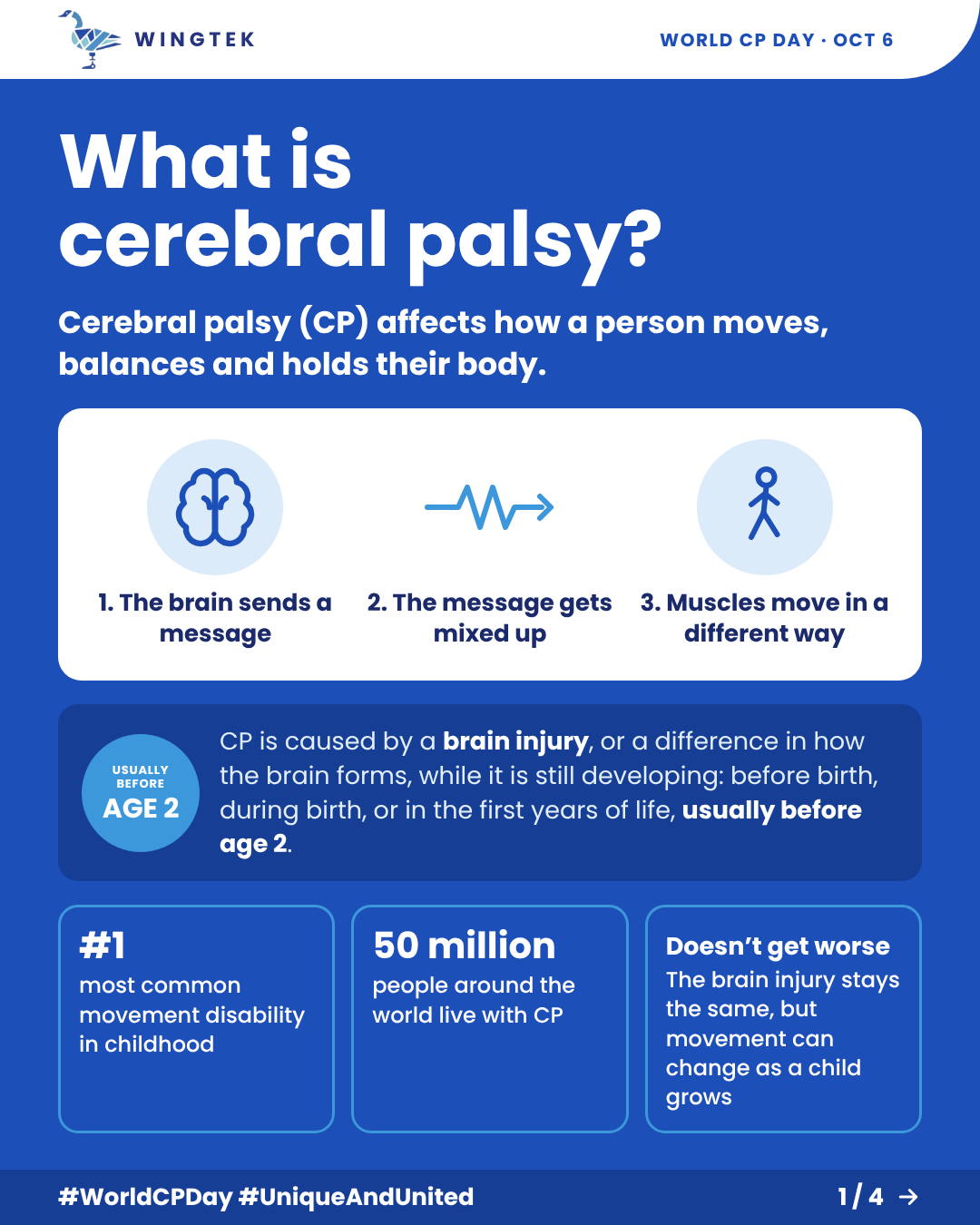
What is cerebral palsy?
Cerebral palsy is a group of conditions that affect a person’s ability to move and keep their balance and posture. The name says it well: “cerebral” means having to do with the brain, and “palsy” means weakness or trouble using the muscles (CDC).
CP is caused by an injury to, or a difference in how, the brain develops. This can happen before birth, during birth, or in the first years of life while the brain is still growing. Most CP starts before or around birth. When it is acquired later, it is usually before age 2.
CP is the most common movement disability in childhood. The brain injury does not get worse over time, but how a person moves can change as they grow and age. No two people experience CP the same way. Some people walk on their own with a slightly different gait. Others use a wheelchair and need support with daily life. Many fall somewhere in between.
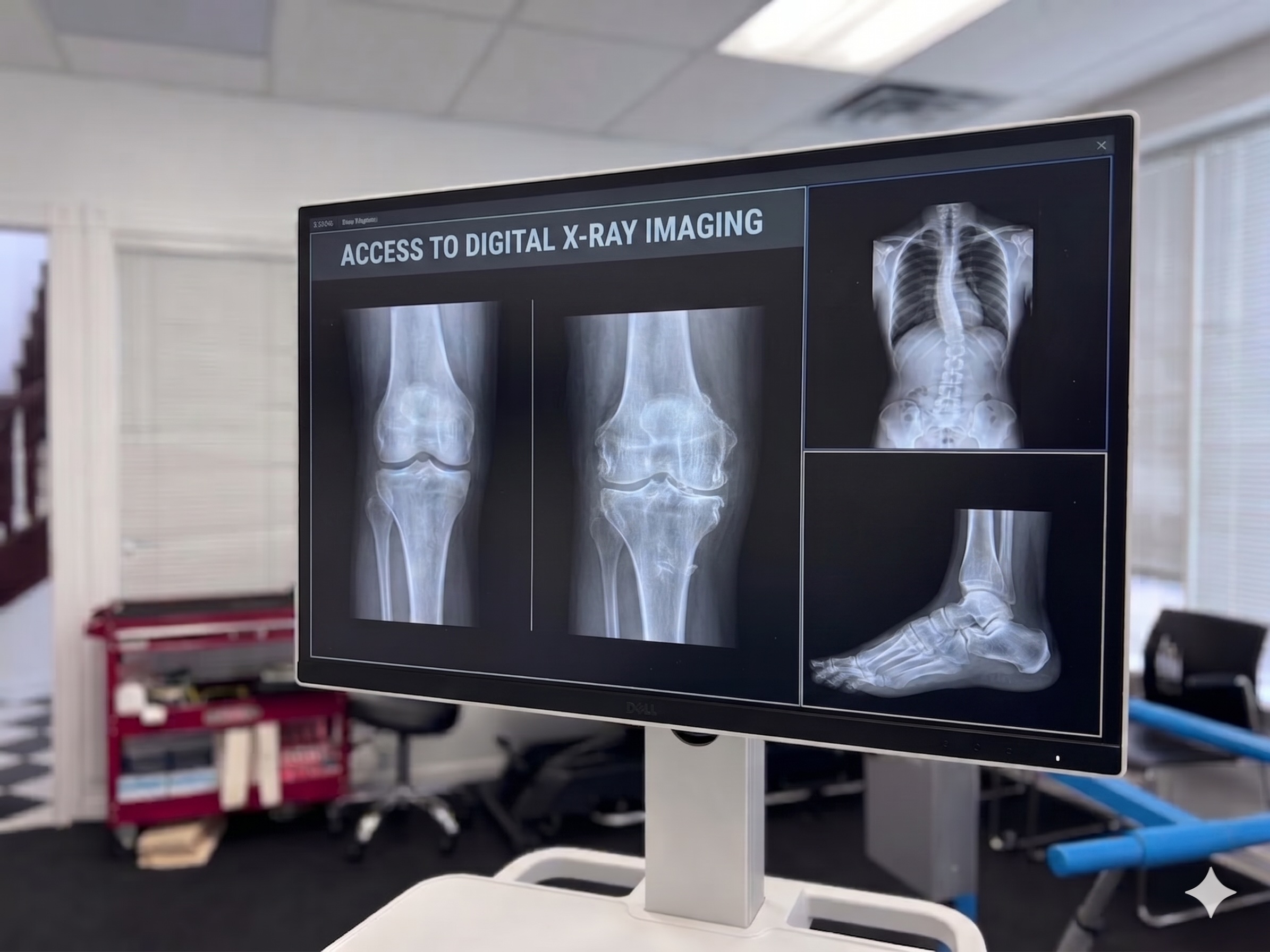
CP can also come with other conditions, such as seizures, vision or hearing differences, speech difficulties, scoliosis, or tight joints (contractures).
The types of cerebral palsy
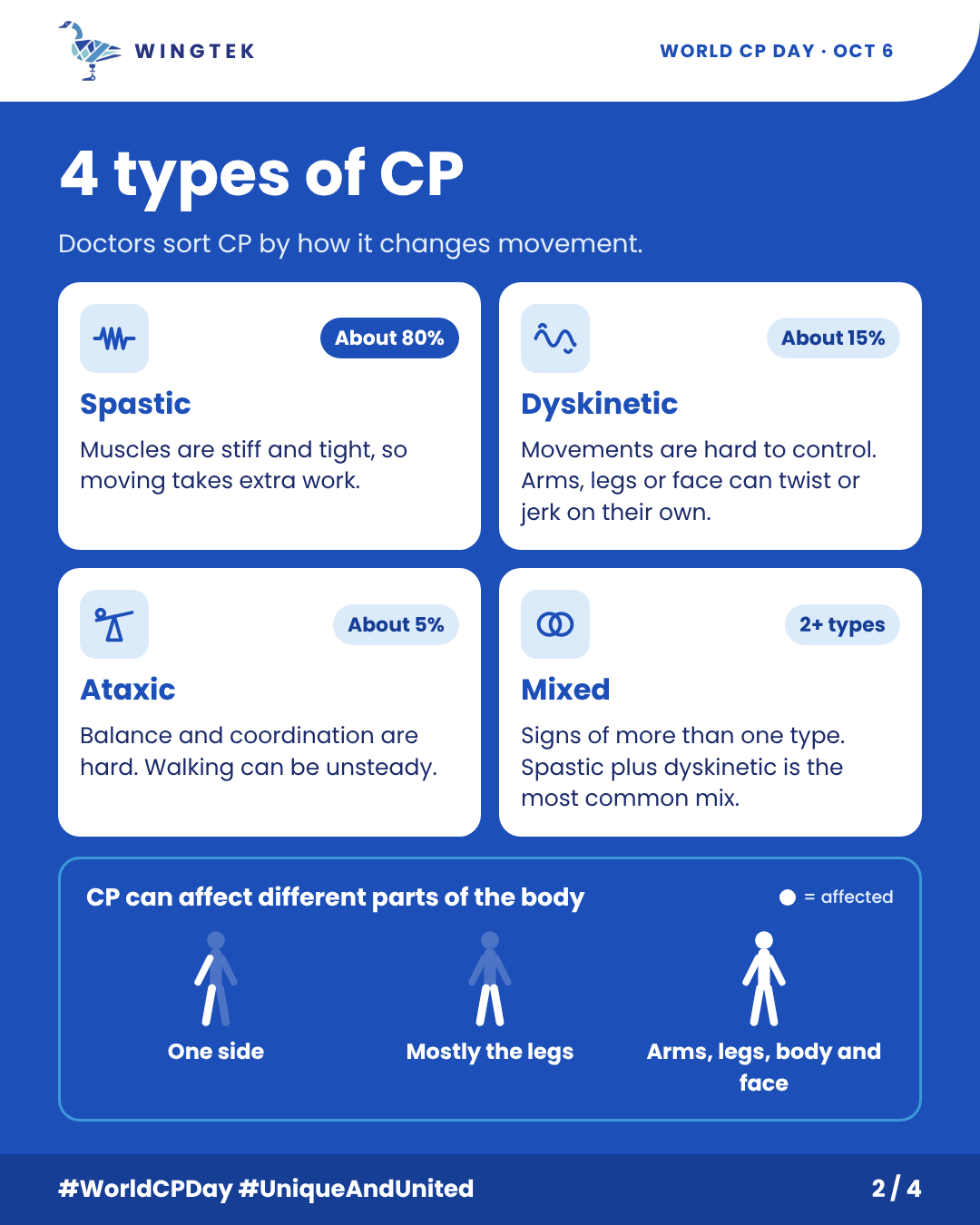
Doctors describe CP by the main way it affects movement.
Spastic CP (about 80%)
Spastic CP is the most common type. Muscles have increased tone, so they feel stiff and tight, and movement takes more effort. It is often described by which parts of the body are affected:
- Hemiplegia: one side of the body, usually the arm more than the leg.
- Diplegia: mainly the legs. The arms may be affected less or not at all.
- Quadriplegia: all four limbs, the trunk and the face. This is the most severe form.
Dyskinetic CP (about 15%)
People with dyskinetic CP have movements they cannot fully control. These can be slow and writhing or quick and jerky, and they can affect the hands, arms, legs, face and swallowing. Muscle tone can shift between tight and loose.
Ataxic CP (about 5%)
Ataxic CP affects balance and coordination. Walking may be unsteady, and quick or precise movements, like writing or reaching for a cup, can be hard.
Mixed CP
Some people have signs of more than one type. The most common mix is spastic and dyskinetic CP.
Why muscles and joints change over time
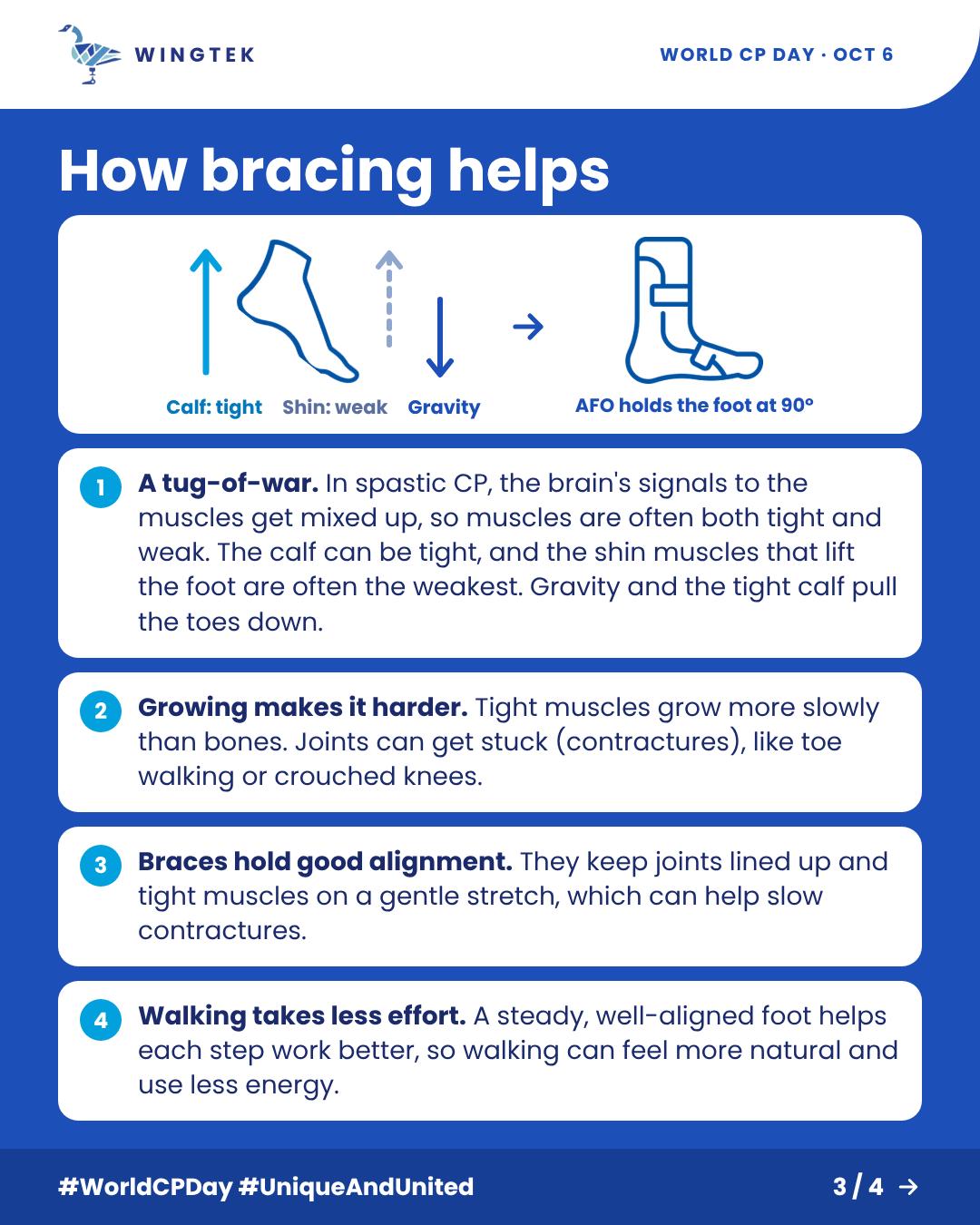
In spastic CP, the brain’s signals to the muscles are mixed up. Muscles are often both tight and weak at the same time. Research shows that both the calf muscles and the shin muscles that lift the foot are weaker than in children without CP, and the shin muscles are often the weakest. When those muscles cannot lift the foot, gravity and a tight calf pull the toes down.
Growth adds another challenge. Muscles affected by CP grow in length more slowly than bones. During growth spurts, muscles can become even tighter. Over time, joints can lose movement and get stuck in one position. These are called contractures. Common examples are toe walking and crouched knees.
How bracing can help
Braces, also called orthoses, are one part of care for many people with CP, alongside physiotherapy, occupational therapy and medical care. Their main goals are to:
- Help correct or prevent deformity by holding joints in good alignment.
- Keep tight muscles on a gentle, sustained stretch, which can help slow contractures.
- Give a stable base of support for standing and walking.
- Support learning new skills, like standing, stepping or sitting balance.
- Make walking more efficient, so it can feel more natural and use less energy.
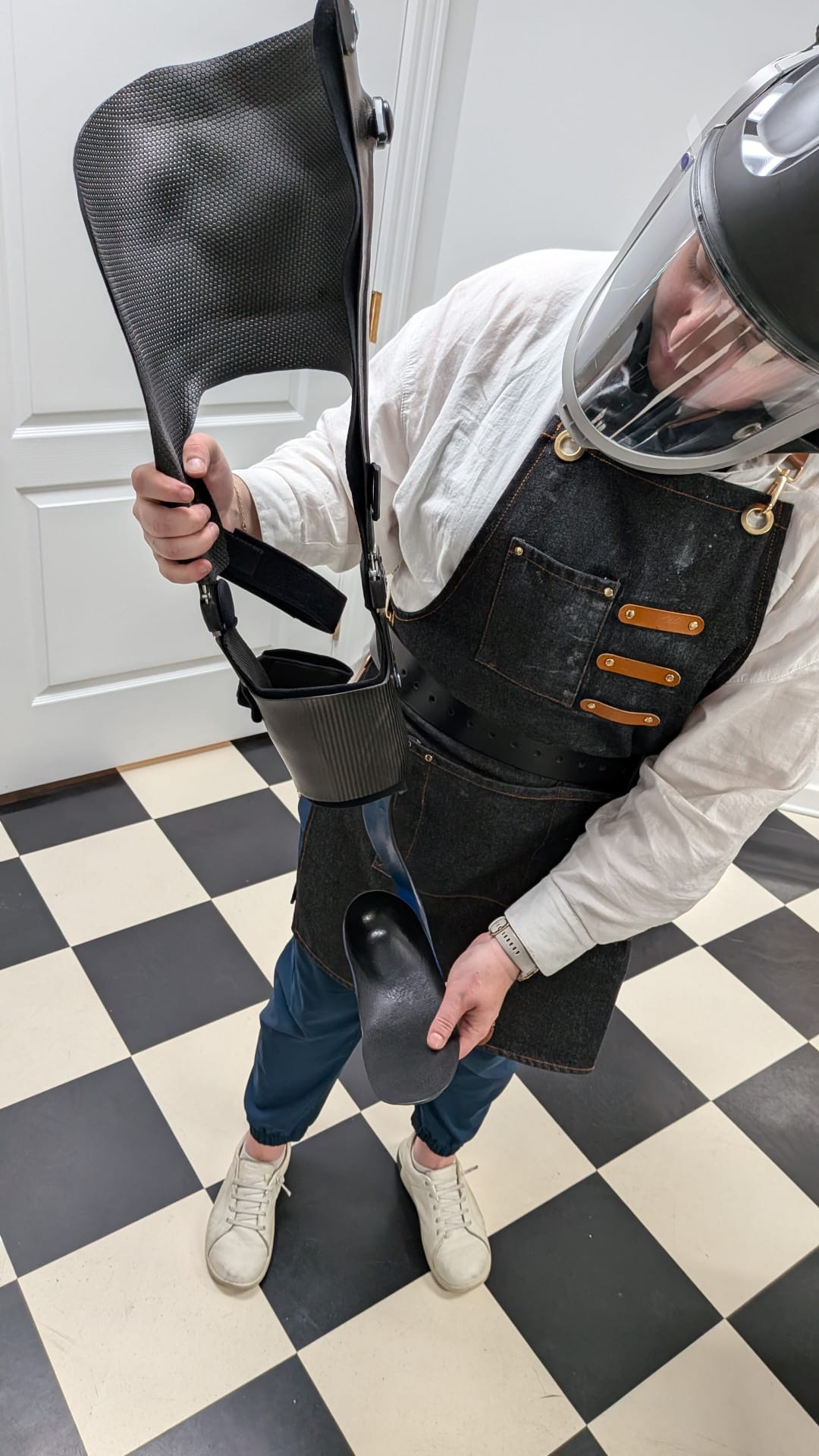
Common braces include foot orthotics, supramalleolar orthoses (SMOs) that end just above the ankle bones, ankle foot orthoses (AFOs), knee ankle foot orthoses (KAFOs), spinal braces and hand or wrist splints. Spinal braces can help with sitting balance and posture, but they do not stop a spinal curve from changing.
Bracing at each GMFCS level
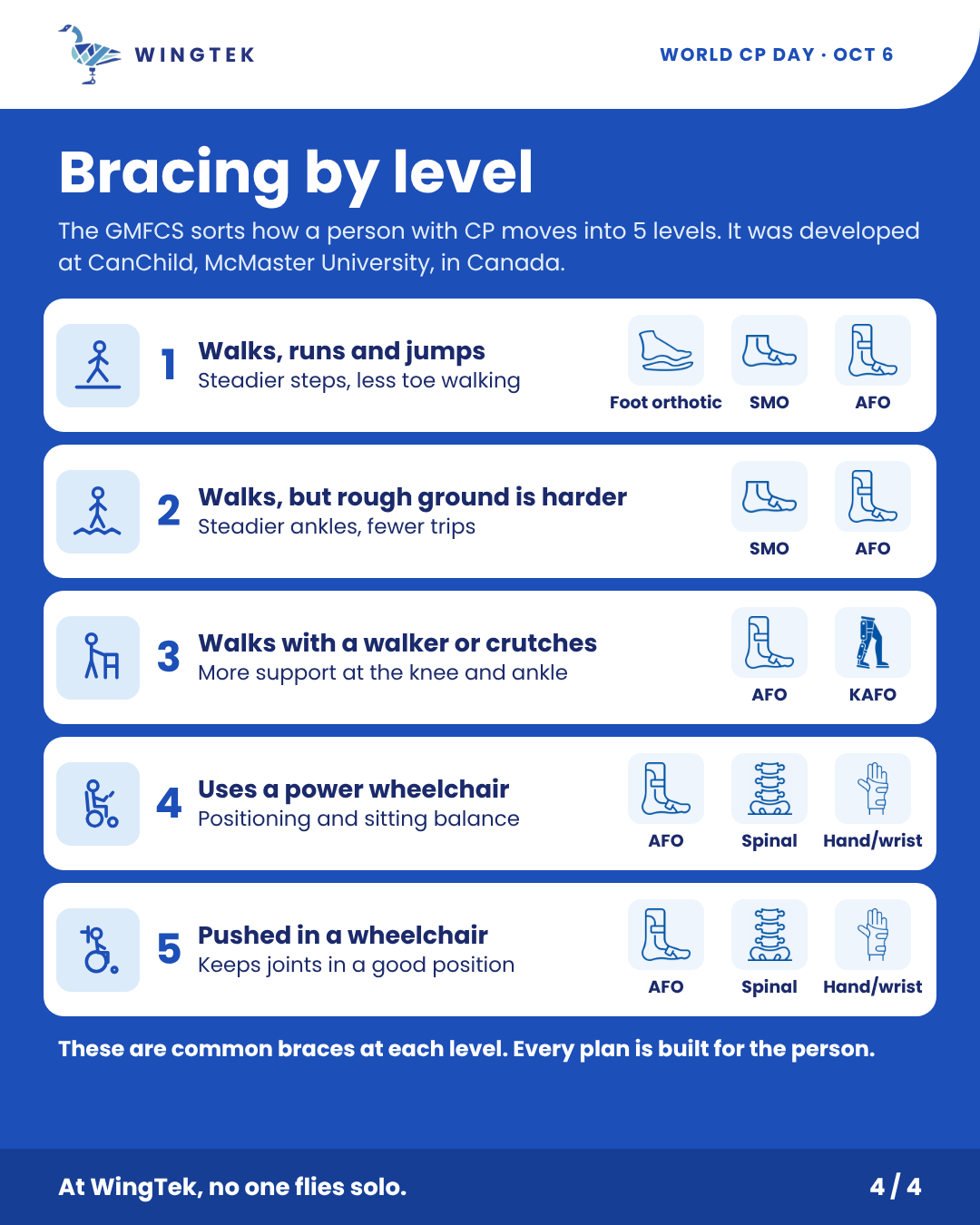
The Gross Motor Function Classification System (GMFCS) describes how a person with CP usually moves at home, at school and in the community. It was developed in Canada by researchers at CanChild, McMaster University. It has 5 levels, from walking without limitations (Level I) to being transported in a manual wheelchair (Level V). The level describes everyday movement. It does not describe the whole person.
| Level | How the person usually moves | Braces often used | What bracing can help with |
|---|---|---|---|
| I | Walks without limitations, but balance, speed and coordination may be harder | Foot orthotic, SMO, AFO | Steadier steps, less toe walking |
| II | Walks with limitations, such as on uneven ground, stairs or long distances | SMO, AFO | Steadier ankles, fewer trips |
| III | Walks using a hand-held mobility device, like a walker or crutches | AFO, KAFO | More support at the knee and ankle |
| IV | Self-mobility is limited. May use a power wheelchair | AFO, spinal, hand or wrist | Positioning and sitting balance |
| V | Transported in a manual wheelchair | AFO, spinal, hand or wrist | Keeping joints in a good position |
These are general patterns. Every bracing plan is built around the person, their goals and their team.
Today we celebrate the 50 million people living with cerebral palsy, and everyone who moves alongside them. Unique and united. Happy World Cerebral Palsy Day.
Sources
- World Cerebral Palsy Day
- World CP Day: Get involved
- CDC: About cerebral palsy
- Cerebral Palsy Alberta: What is CP
- PedsCases: Cerebral palsy
- CanChild: GMFCS Expanded and Revised
- Frontiers in Neurology (2021): Muscle weakness in CP
- Frontiers in Rehabilitation Sciences (2022): Impaired muscle growth
- Cerebral Palsy Scotland: Growth spurts
- Orthotics in Cerebral Palsy (Physiopedia)
- Hanger: Neuromuscular scoliosis