Noticed a flat spot on your baby’s head? Flat head is common, it is not just cosmetic, and it responds best when caught early. Learn the four head shapes, why head shape matters, how tummy time helps, and when to check.
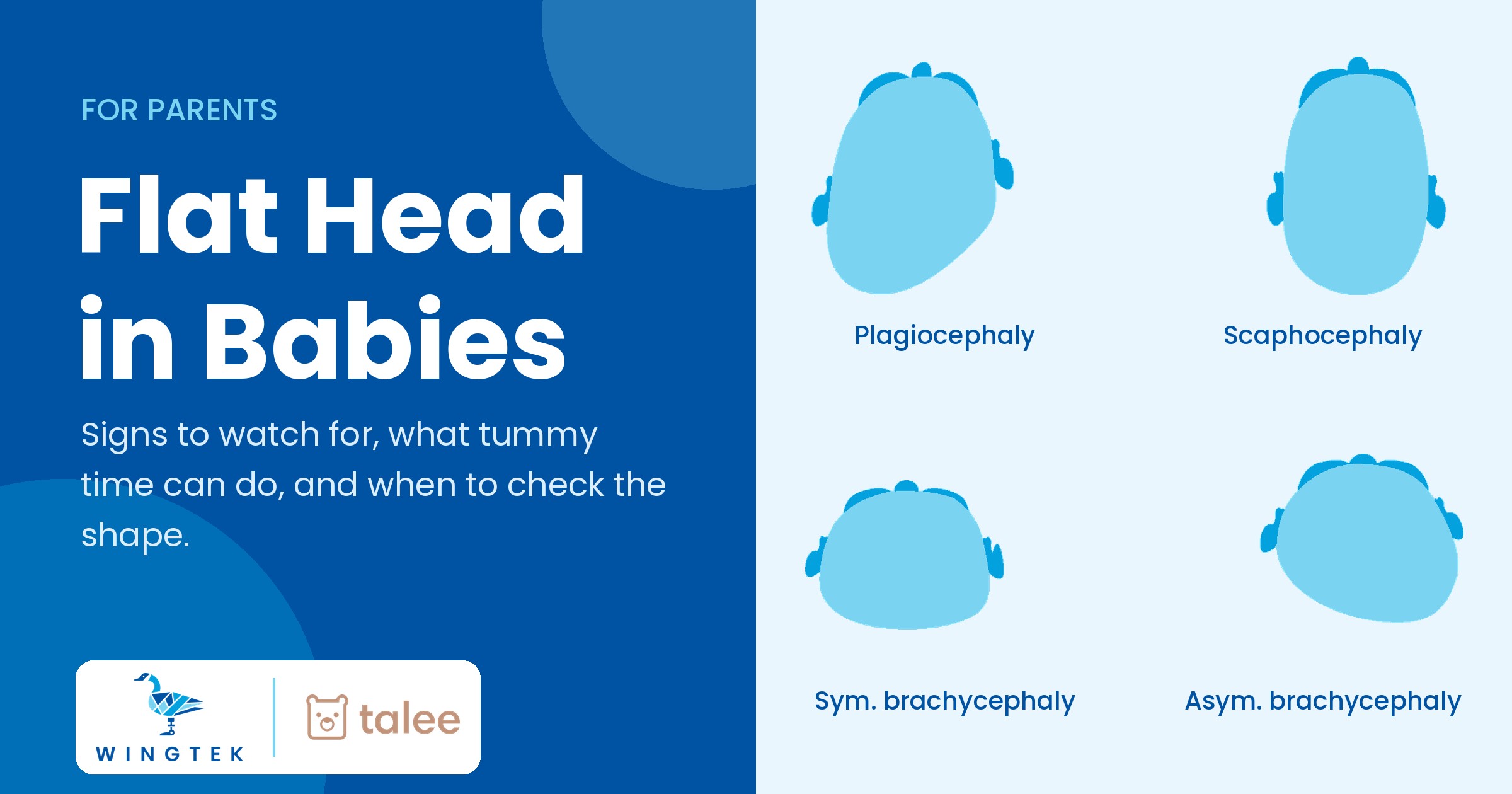
Noticed a flat spot on the back of your baby’s head? You are not alone. Flat head, called positional plagiocephaly or brachycephaly, is one of the most common things parents ask about in the first year. A baby’s skull grows faster in the first year than at any other time in life. That growth is what makes flat spots easy to develop, and also what makes them possible to correct. The window is short, so knowing what to look for, and when, makes a real difference.
This guide from WingTek Orthotics and Prosthetics in Emerald Park, just outside Regina, Saskatchewan, walks you through why flat head happens, why it matters, what you can do at home, and when to have your baby’s head shape checked.
What causes flat head in babies?
Placing babies on their backs to sleep is one of the most important things parents do. Since the 1990s, back sleeping has cut the rate of Sudden Infant Death Syndrome (SIDS) by about half (Orthotics Prosthetics Canada). Keep doing it.
A newborn’s skull is soft so it can grow quickly with the brain. When a baby spends long stretches resting on the same spot, growth in that area is held back and pushed elsewhere, and a flat spot can form. Most flat spots develop in the first 3 months, and about 1 in 5 are present at birth.
Flat head is common. Invent Medical, the maker of Talee helmets, reports that positional head shape changes affect about 1 in 10 babies. A Calgary study found some degree of flattening in nearly half of 2-month-olds, though most cases were mild.
Why a flat head matters: it’s not just cosmetic
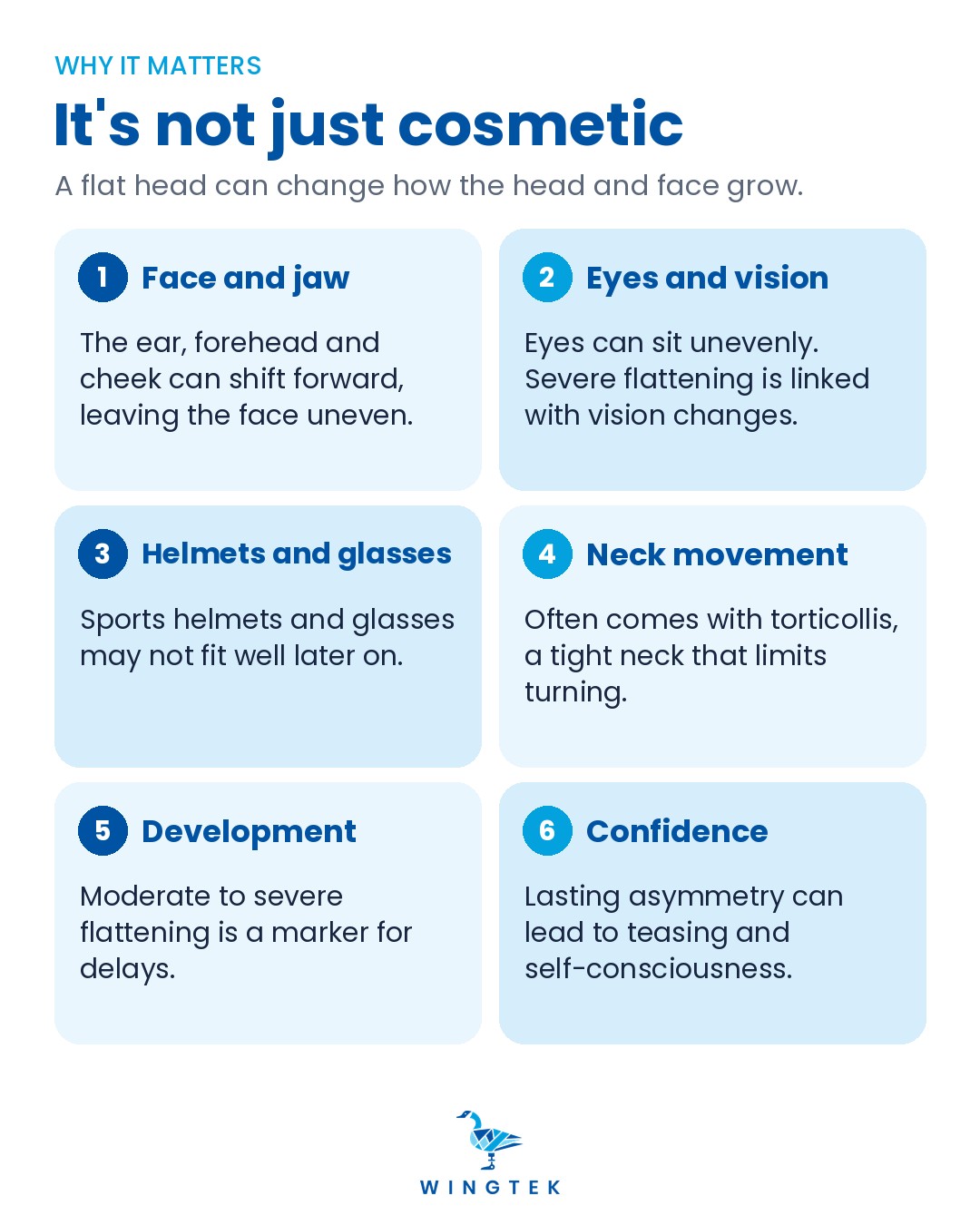
Many parents are told a flat spot is “just cosmetic.” Head shape is about more than looks. As the skull grows, a flat area can change how the whole head and face develop. Orthotics Prosthetics Canada and Invent Medical both describe reasons to take it seriously.
The good news: the earlier a flat head is noticed, the more can be done about it.
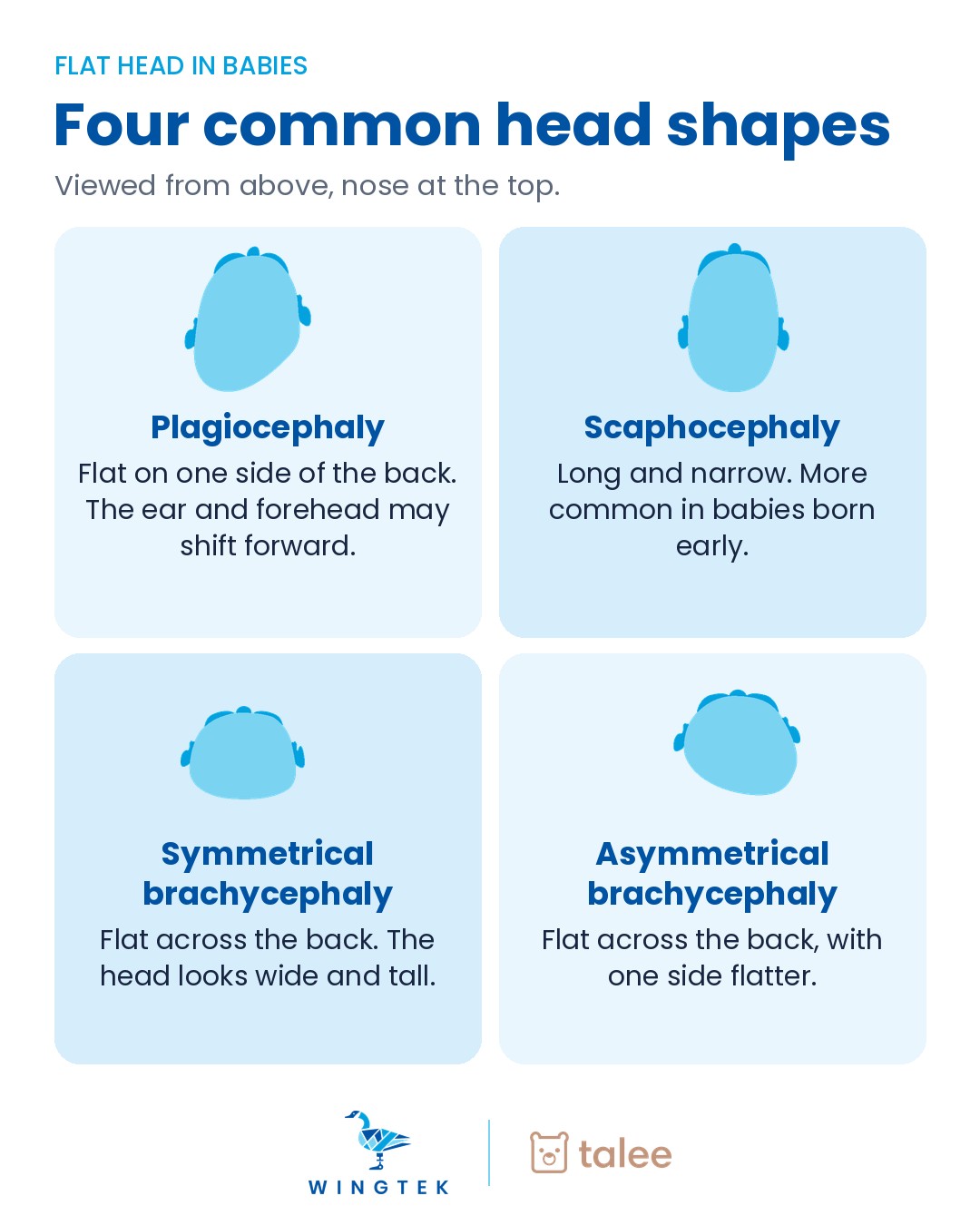
Types of flat head: the four common head shapes
Is my baby at higher risk of flat head?
Some babies are more likely to develop a flat head:
- Boys
- Babies who prefer to turn their head one way
- Babies with torticollis
- Twins and multiples
- Babies who had a tight fit in the womb or an assisted delivery
- Babies who spend long periods on their backs while awake, including in car seats, swings and bouncers
Torticollis and flat head
Torticollis is tightness in a neck muscle that makes a baby tilt their head to one side and turn toward the other. Turning both ways is hard, so the baby keeps resting on the same spot. If your baby always looks one way, ask your doctor about a pediatric physiotherapist. Treating the neck is an important part of improving head shape.
How to prevent flat head at home: tummy time and repositioning
Tummy time and repositioning are the first steps for every baby. They work well, especially in the first 3 months.
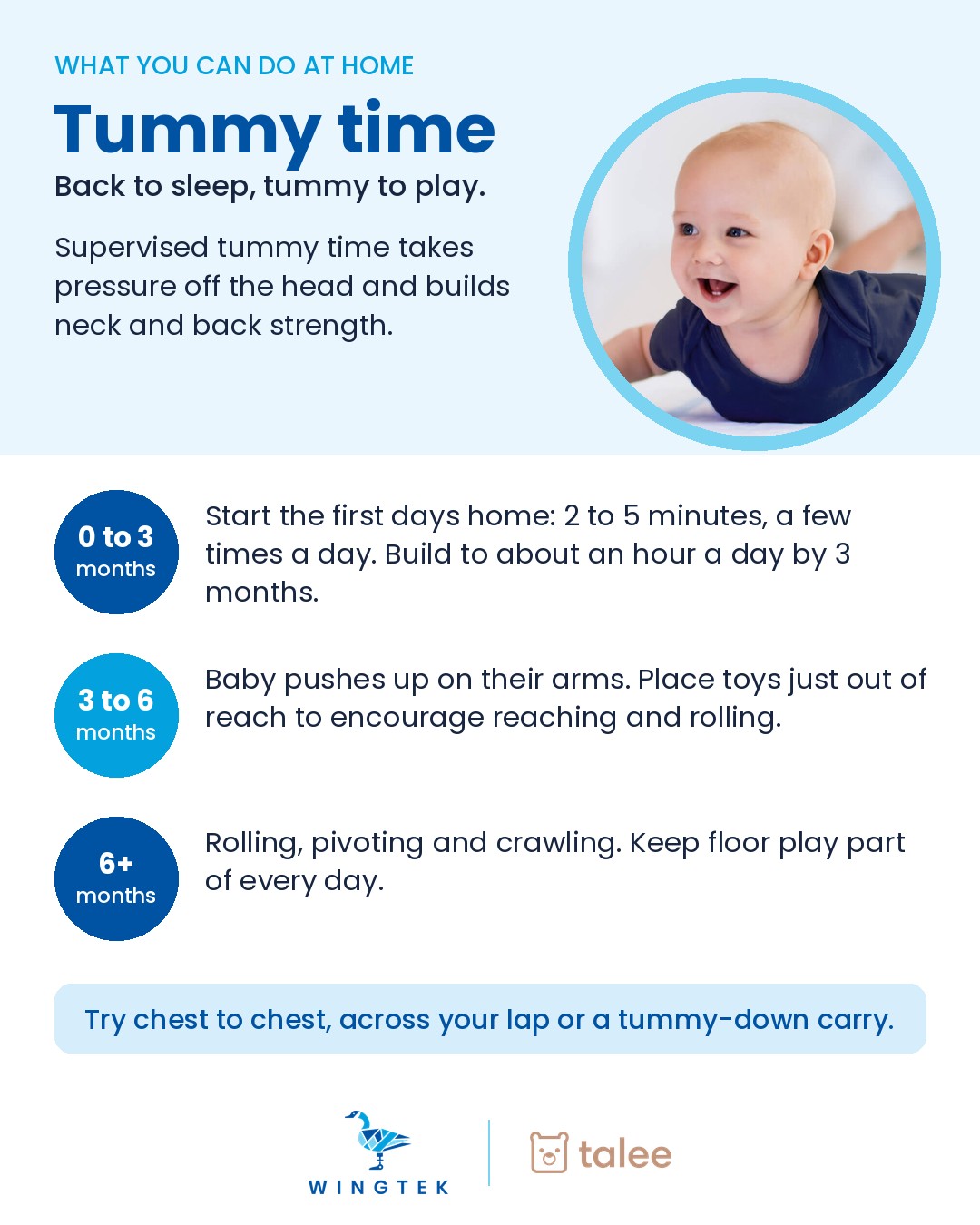
Everyday positioning
- Alternate which end of the crib your baby’s head is at, so they turn toward the room from both sides.
- Switch the arm you hold your baby in for feeding.
- Talk to your baby and place toys on the side they turn to less.
- Keep car seats for the car. Limit time in swings, bouncers and reclined seats.
What to avoid
Positioning pillows and sleep positioners in the crib are not recommended by Health Canada, because they can increase the risk of suffocation. A firm, flat mattress with nothing else in the crib is still the safest way to sleep.
When to check your baby’s head shape
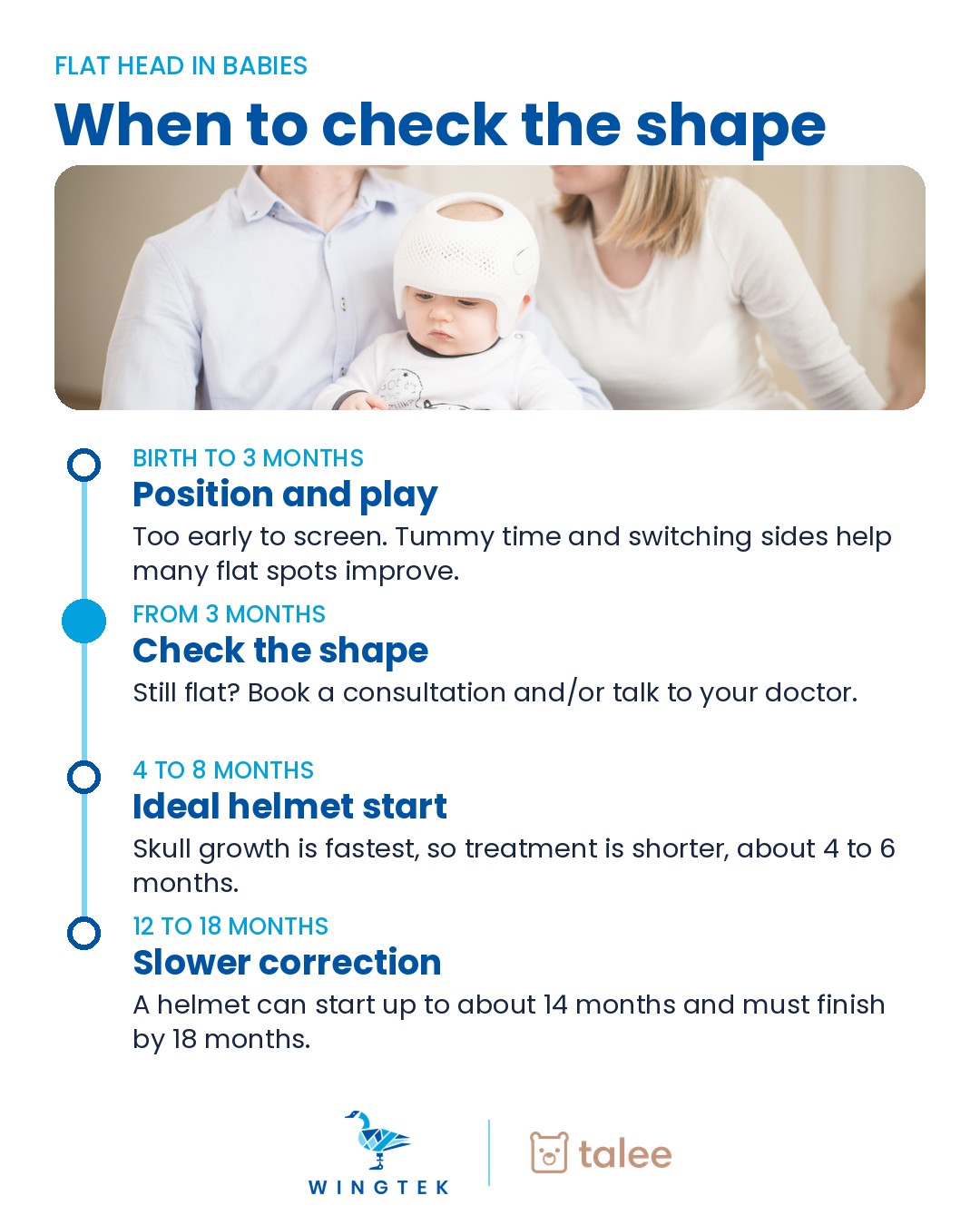
A simple check at home: look down at your baby’s head from above, ideally at bath time when the hair is wet. Is one side of the back flatter? Is one ear further forward? Does the forehead look uneven? Does your baby turn easily both ways?
Flat head or craniosynostosis? When to see your doctor first
Most flat head shapes are positional. Rarely, an unusual head shape is caused by craniosynostosis, where one or more of the skull’s growth seams closes too early. This needs to be assessed by a physician or specialist before any helmet treatment.
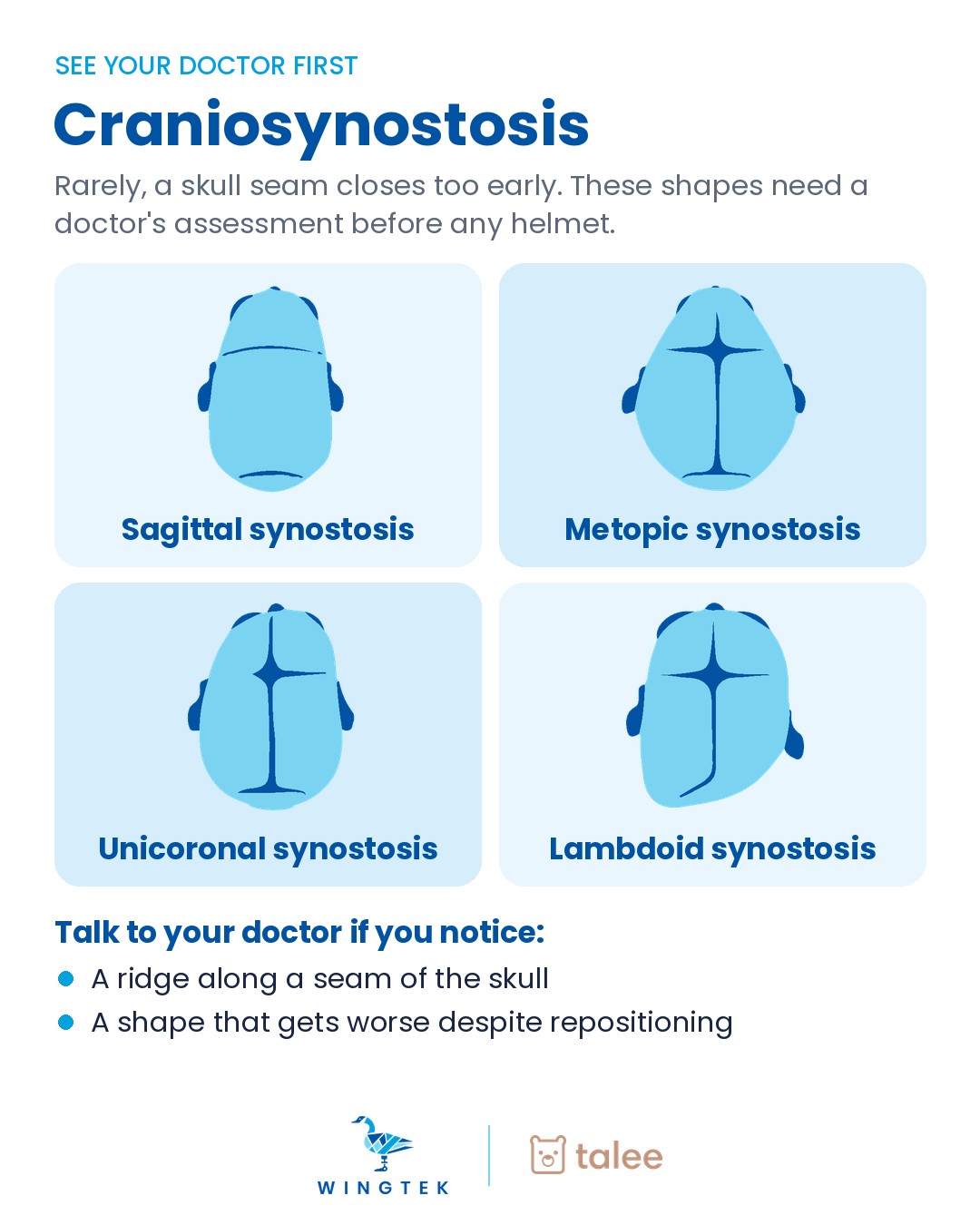
Also see your doctor if your baby’s head is growing slowly, or the shape does not match the common patterns above.
How we measure flat head: a 3D scan, not a guess
You would not guess your baby’s weight at a checkup. Head shape deserves the same objectivity. At WingTek, a head shape consultation includes a quick, non-contact 3D scan. Nothing touches your baby’s head.
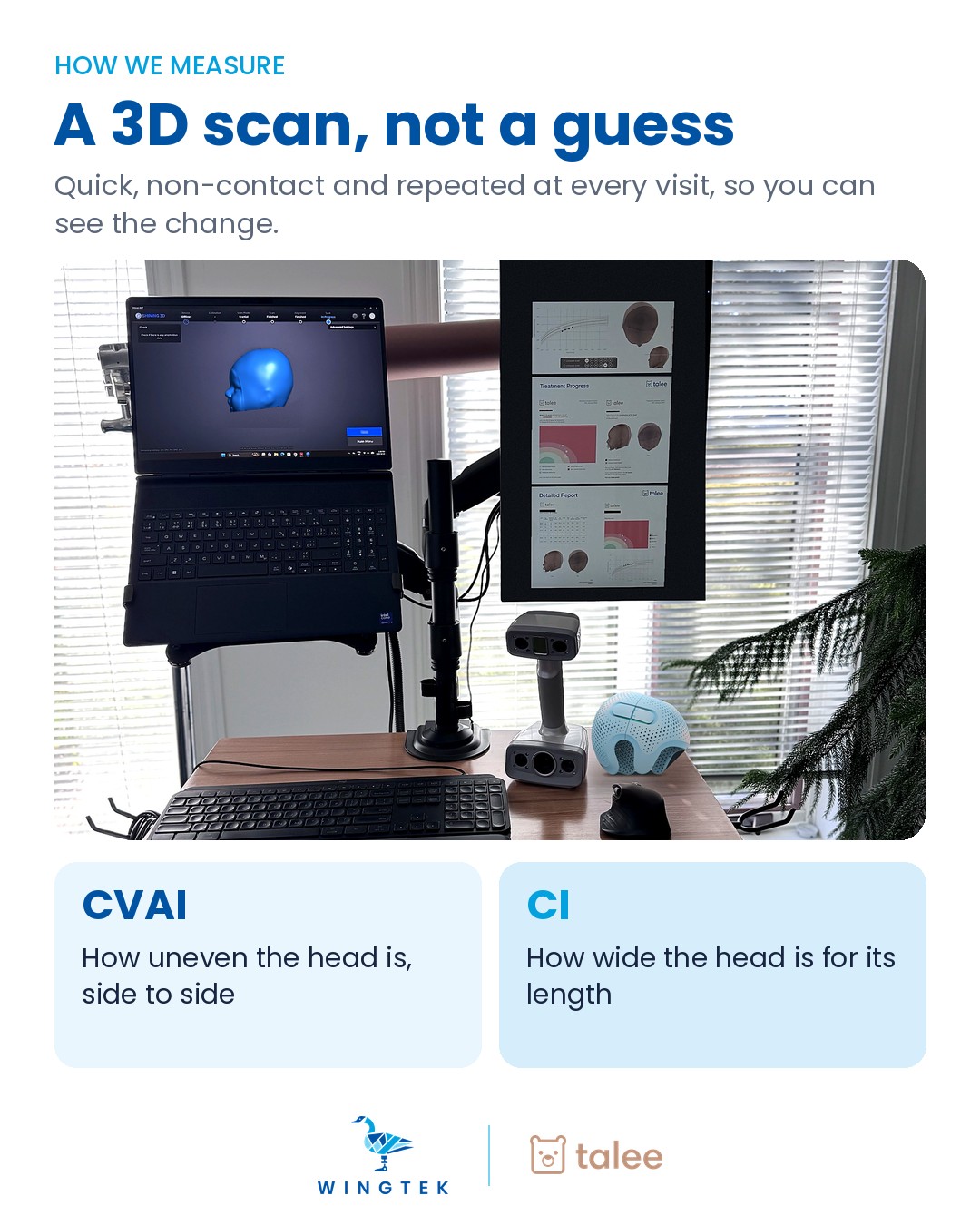
From the scan we calculate two numbers, CVAI and CI, that place your baby’s head shape in a severity range. Mild flattening often does well with repositioning guidance, and we can rescan to monitor. For moderate to severe flattening, you and your baby’s doctor receive a report with the measurements, so decisions are based on data.
If treatment goes ahead, we scan at every visit and compare it with the last. You see the change in charts, 2D cross-sections and 3D views, not just our impression.
Baby helmet treatment for flat head
A cranial remolding helmet does not squeeze. It touches the rounder areas of the head and leaves space over the flat areas, so as your baby grows, the head grows into that space. Certified Orthotists, CO(c), are the professionals most qualified to provide this treatment (Orthotics Prosthetics Canada).
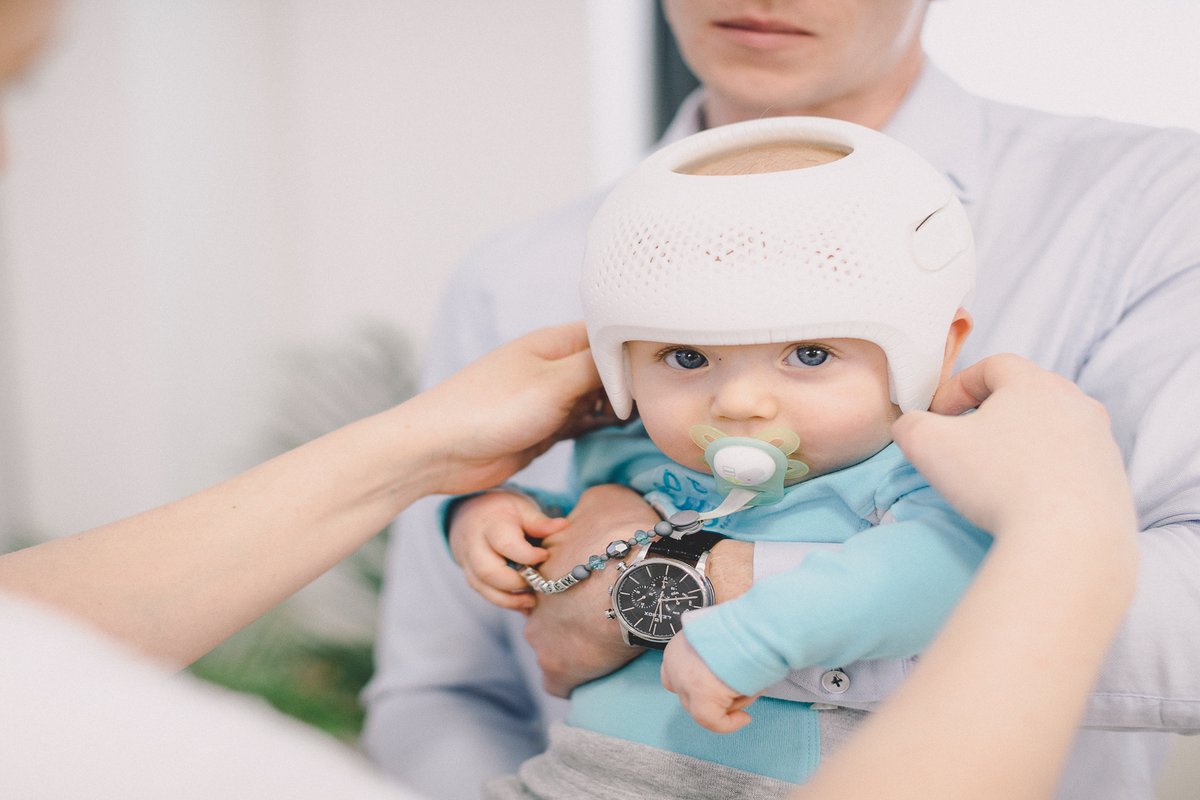
At WingTek we use Talee helmets, developed and made by Invent Medical. We chose Talee for the data and visual reports it gives families, and for how one helmet adjusts as babies grow.
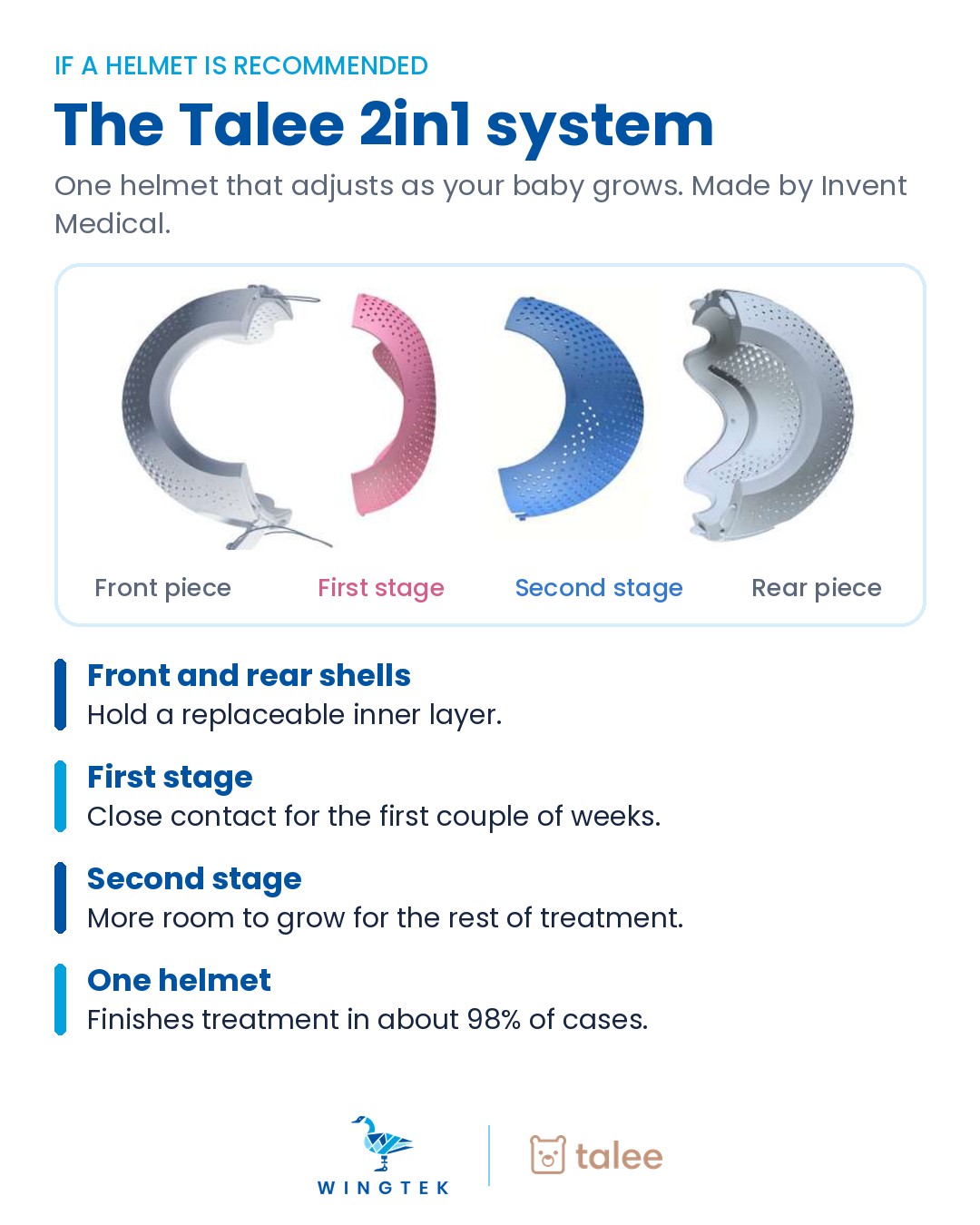
- Breathable and light: a thin, perforated, 3D-printed shell.
- Made for your baby: families choose a colour, a name and a symbol.
- Support at home: the Talee Parents app guides families between visits.
The helmet is introduced gradually over 5 days, then worn about 23 hours a day. Treatment usually lasts 4 to 6 months for babies under 12 months. In one Invent Medical case example, a baby who started at 4.9 months went from a CVAI of 17.7% to 4.6% over 4.6 months.
At WingTek, production is fast-tracked. Our goal is to fit your baby’s helmet within 14 days of the scan, which allows time for production and delivery. Follow-up visits, usually 5 to 6, each include a scan, so every adjustment is guided by measured change.
Flat head in babies: common questions
Is a flat head just cosmetic?
No. A flat head can shift the ears, forehead, cheeks and jaw, and can affect how the eyes line up. It can make protective helmets and glasses fit poorly later in life, and it often comes with neck tightness. Moderate to severe flattening is also a marker of higher risk for developmental delays. That is why it is worth checking early.
Does the scan hurt?
No. The scan is non-contact and takes only a few moments.
Does a flat head affect my baby’s development?
Research has found higher rates of later developmental delays in children who had moderate to severe flattening as babies. It is not known that flattening causes these delays. It may be a sign that a baby benefits from closer follow-up, which is one more reason to involve your pediatrician and physiotherapist.
Will a flat head go away on its own?
Head shape can improve with growth, but it may not fully correct, and some asymmetry can last into childhood. Measuring gives you the facts to decide.
When is the best age for a baby helmet?
Screening starts after 3 months. If a helmet is needed, the ideal time to start is 4 to 8 months, while the skull is growing fastest. A helmet can still start up to about 14 months and must finish by 18 months.
Should we keep putting our baby to sleep on their back?
Yes. Back to sleep, tummy to play.
Do I need a referral?
You can book a consultation with WingTek and/or ask your doctor for a referral. Ideally, babies with a flat head are also seen by a pediatric physiotherapist and a pediatrician, so neck movement, development and head shape are looked at together.
Book a flat head consultation near Regina
If you notice a flat spot, or your baby always turns one way, start tummy time and repositioning today. If the flat spot is still there after 3 months, book a head shape consultation with WingTek in Emerald Park, just outside Regina, and/or ask your doctor. Call or text 306-566-4666, or send us a message online.
Back to sleep, tummy to play, and check the shape.